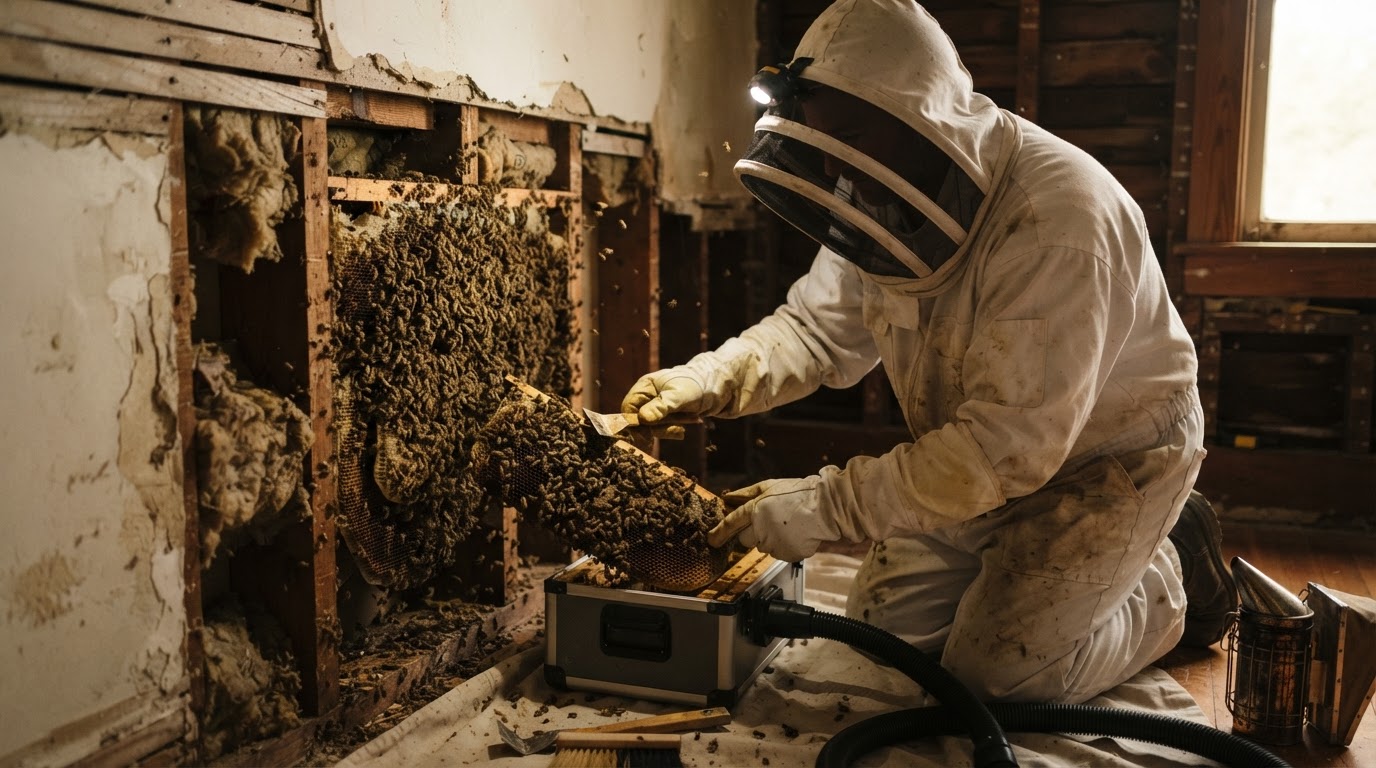
Emergency Bee Removal in Seattle, Washington
Assessment and removal of established honeybee colonies inside walls, roofs, and chimneys when bees have moved indoors. Call for current availability.
Emergency Bee Removal in Seattle
When honeybees have moved into a wall, roof, chimney, or attic and started building comb, it is no longer a swarm capture — it is an established colony inside a structure. That situation can escalate quickly: bees indoors, honey and comb building up inside the cavity, and a growing colony that attracts more bees and other pests if it isn't removed. Queen B Bee Hive Removal Seattle handles established colony removals across Seattle and the surrounding King County area. Call us with your address and what you're seeing, and we'll confirm current availability and schedule the right removal.
An established colony removal means opening the cavity, extracting the comb and honey, removing the bees, and sealing the entry point to reduce the chance of a new swarm moving straight back in. It is a bigger job than a resting swarm, and it is the one most likely to need a prompt response because bees indoors or a colony near living space is an active problem.
Every emergency removal starts with an assessment of where the colony is, how far it has spread inside the cavity, and what structure is involved, so we can plan the access and the cleanup before we start cutting.
When bees indoors becomes an emergency
A few bees inside a room is often just scouts or strays. A steady stream of bees entering and exiting a single point on an exterior wall, bees appearing inside the house near a wall or ceiling, or a humming sound from inside a wall or ceiling are signs of an established colony. That is the point to call us with your address and what you're seeing so we can confirm availability and plan the removal.
An established colony doesn't stay small. The bees build comb, store honey, and raise more bees inside the cavity. Left alone, the comb and honey can melt or leak, stain walls, attract roaches, ants, and rodents, and the colony keeps growing. The sooner it is removed, the less invasive the work.
If someone is having an allergic reaction to stings, call 911 or your local emergency medical services first. This is a pest trade service, not a medical response — we handle the colony once the person is safe.
Where colonies establish inside structures
Honeybees look for a protected, dark cavity with a small entrance. Around Seattle homes that usually means a wall void, an attic or crawlspace, or a chimney. The location determines how we access and remove the colony.
Walls and wall voids
What and where: a colony that has moved into the space between exterior and interior walls, with bees entering through a gap, vent, or crack.
How: we locate the extent of the comb inside the wall, open the cavity from the exterior or interior, remove the comb and honey and the bees, and close up the access. Any broader repair or restoration is assessed and quoted separately.
Outcome: the colony and its comb are out of the wall, the cavity is cleaned, and the entry point is sealed to reduce the chance of a new swarm moving back into the same void.
Roofs, attics, and chimneys
What and where: a colony established in an attic, under a roof, or inside a chimney chase — often discovered by bees appearing near a ceiling or fireplace or by humming overhead.
How: we access the cavity through the roof, attic hatch, or chimney, remove the comb and honey and the bees, and seal the entry point on the roof or flashing.
Outcome: the colony is removed from the structure, the comb and honey that could attract pests or leak are cleared, and the entry is sealed to reduce the chance of recolonization.
Removal method for established colonies
An established colony removal is a structural job. We locate the full extent of the comb — bees don't build in a neat square, so the comb can spread further inside the cavity than the entry point suggests — then open the cavity, remove all the comb and honey, extract or relocate the bees, and clean the space.
Removing the comb matters as much as removing the bees. Comb and honey left inside a wall or attic will melt in warm weather, stain and damage the structure, and attract roaches, ants, mice, and a new swarm of bees. A removal that leaves the comb is not a finished job.
Honey, comb, and structural cleanup
Once the colony and comb are out, the cavity is cleaned and the entry point is sealed. Sealing the entry is what lowers the chance of a new swarm moving into the same void the following season — bees are attracted to the smell of old comb and honey, so an unsealed cavity with residue is more likely to be reoccupied.
Where access requires cutting into a wall or roof, the opening is closed up so the structure is sealed again. Any broader repair or restoration beyond closing the access is assessed, quoted, and authorized separately. The goal is a cavity that is empty, clean, and sealed, not just a colony that is gone.
Urgent response and availability
Established colonies are the situation most likely to need a prompt response — bees indoors, a colony near living space, or comb building up where it can damage the structure. Call us with your address, where the bees are, and what you're seeing, and we'll confirm current availability and timing. We don't promise a fixed response time or 24/7 coverage.
Keep people and pets away from the entry point and don't seal it from the outside. The sooner an established colony is assessed and removed, the smaller the job and the less damage to the structure — so call rather than wait.
What to tell us about an emergency
To assess availability and plan the visit, tell us where the bees are — a wall, roof, attic, or chimney — and what you're seeing: a steady stream in and out of one point, bees indoors, or humming from inside a cavity. How long it's been going on helps us gauge how far the comb may have spread.
Keep people and pets away from the entry point and don't seal it from the outside. Sealing the entry traps the colony inside, and the bees will search for another way out — often into the living space. Don't spray or disturb the area before we arrive.
If structural access is needed, we'll explain what's involved before we start. Reaching the full extent of the comb can mean opening a wall or roof, and we close up the access so the structure is sealed again. Any broader repair or restoration is assessed and quoted separately.
Service area for emergency removal
We respond to established colony removals across Seattle and the surrounding King County communities. For an active emergency, call directly; for assessment outside the city, check our service areas page to confirm we reach your neighborhood.
Ready to get the bees handled?
Tell us where the swarm, nest, or colony is and what you're seeing. We'll assess the situation and schedule the right removal for your Seattle property.
Or call 206-672-6310Not sure which service you need? Compare all services.