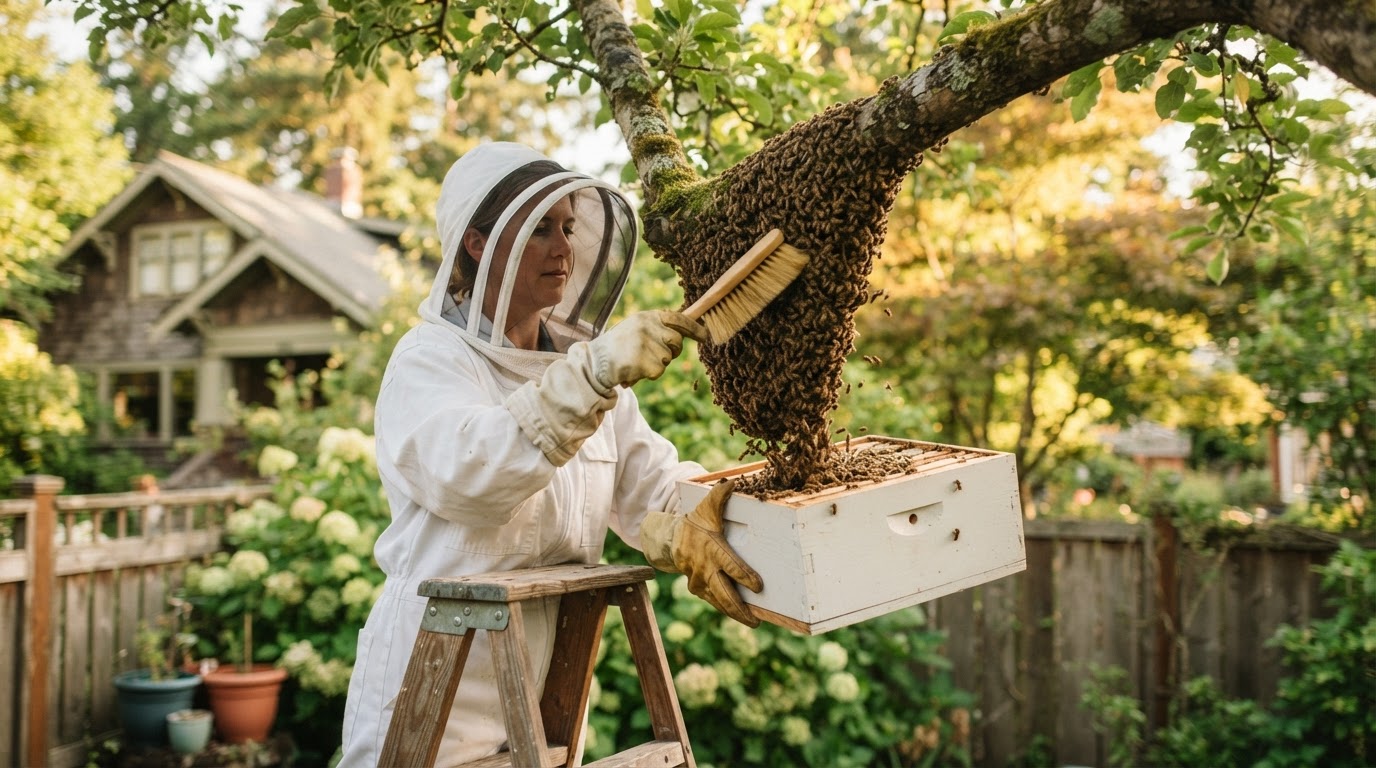
Bee Swarm Removal in Seattle, Washington
Live capture and relocation of resting honeybee swarms from yards, fences, and low branches across Seattle.
Bee Swarm Removal in Seattle
A honeybee swarm is a cluster of several thousand bees that has left an existing hive because that colony grew too crowded. The bees land together on a branch, fence, post, or shrub while scout bees search for a permanent cavity to move into. In Seattle, swarms most often appear from late spring into early summer, and a resting swarm is the cleanest, safest moment to capture a colony live and relocate it.
Queen B Bee Hive Removal Seattle collects resting swarms across Seattle and the surrounding King County area rather than spraying them. A swarm at rest is usually docile — the bees are full of honey and focused on finding a new home — but it will not stay put for long, and if it moves into a wall or attic it becomes a much bigger job. Homeowners, property managers, and businesses call us when a cluster appears in a yard, on a fence, or hanging from low branches near foot traffic.
Every swarm removal starts with an assessment of the cluster's size, height, and access, then a live capture suited to where it is resting. The goal is to relocate the colony intact and keep it from settling inside a structure.
What a honeybee swarm is — and why it shows up
A colony that survived winter builds up fast once spring forage opens up. When a hive gets crowded, the bees raise a new queen and the old queen leaves with roughly half the colony — that departing mass is the swarm. Before it leaves, the bees gorge on honey, which makes them calm and slows their flight. They cluster on the first convenient surface they find and send scouts out to locate a dark, protected cavity.
That resting cluster is temporary. It may stay for a few hours or a couple of days while scouts look for a suitable home. If they find one — a wall void, an attic, a chimney, an empty box — the whole swarm moves in and starts building comb. Catching the swarm before it relocates is far simpler and less invasive than removing an established colony from inside a structure.
Recognizing a swarm early matters. A tight, football-sized cluster of bees hanging quietly in one spot, with bees flying in and out but not defending a nest entrance, is almost always a resting swarm. That is the moment to call for live capture.
How we assess and capture swarms
Capture method depends on where the swarm has landed and how high or hard to reach it is. We assess the cluster's size, height, and access first, then choose a professional capture approach suited to the spot — collecting the cluster into a transport box and relocating it rather than spraying it. We'll explain the access and any limits before we start.
Low branches, fences, and shrubs
What and where: a swarm clustered on a low branch, fence rail, post, or shrub in a Seattle yard — the most common and most accessible situation.
How: we assess the cluster and use a professional capture method suited to where it's resting, collecting the bees into a transport box for relocation.
Outcome: the cluster is collected and relocated. Some flying bees may remain in the area briefly as they return — we'll explain what to expect and any follow-up based on what we find on site.
Elevated or awkward access
What and where: a swarm that has landed higher up — in a tree canopy, under a second-story eave, on a roof edge, or tangled in dense growth where access is more difficult.
How: we assess whether the cluster is safely reachable with our access equipment, and use a contained capture method suited to the height and branch angle. If it isn't safely reachable, we'll explain the limit and the options.
Outcome: the cluster is collected where accessible and relocated. We'll explain any residual activity and follow-up based on the assessment.
When a resting swarm turns into an established colony
If a swarm isn't captured within a day or two, the scouts usually find a cavity and the whole cluster moves in. Once bees are inside a wall, roof, chimney, or attic and start building comb, the job changes from a swarm capture to a structural colony removal — opening the cavity, clearing comb and honey, and sealing the entry point.
That is a bigger, more involved job, and it is the situation our emergency bee removal service is built for. The sooner a resting swarm is collected, the more likely it stays a simple live-capture instead of a structural project.
What to do while you wait for capture
Keep your distance and keep children and pets away from the cluster. A resting swarm is generally docile, but it is still a large number of bees in one place, and they will defend themselves if grabbed, sprayed, or disturbed.
Do not spray the swarm with insecticide or water, and don't try to knock it down or seal it into anything. Spraying kills useful pollinators and can leave angry bees scattered through the yard; knocking a cluster down spreads the bees out and makes capture harder. Note where the cluster is and roughly how large it is so we can bring the right gear.
Timing across the Seattle season
Swarm season in the Pacific Northwest runs roughly from late spring into early summer, with warm, sunny afternoons after a stretch of build-up being the peak window. Outside that window, swarms are less common but still happen — a late split or an overcrowded hive can throw a swarm into summer.
Because a resting swarm may move on, contact promptly; keep people and pets away and do not disturb it. We'll confirm current availability and the right capture approach for the spot.
Service area for swarm removal
We capture and relocate swarms across Seattle and the surrounding King County communities. If you're outside the city, check our service areas page to confirm we reach your neighborhood before booking.
Ready to get the bees handled?
Tell us where the swarm, nest, or colony is and what you're seeing. We'll assess the situation and schedule the right removal for your Seattle property.
Or call 206-672-6310Not sure which service you need? Compare all services.